
Buying an electric scooter can feel exciting. You have probably looked at different models, compared prices, checked claimed range figures, and imagined replacing your regular commute with a quieter and potentially more economical ride.
But before making the final payment, it is worth taking a step back.
An electric scooter is not just another everyday purchase. It is a vehicle that you may depend on for commuting, shopping, family trips, business use, or daily transportation. The right model should fit your lifestyle, budget, roads, charging routine, and performance expectations.
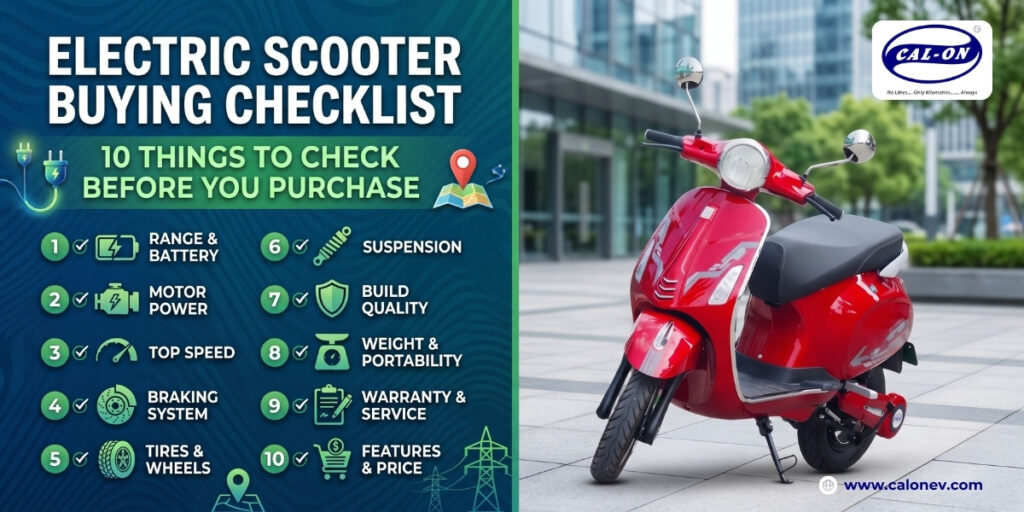
This is where an electric scooter buying checklist becomes useful. Instead of making a decision based only on design or price, you can systematically evaluate the important areas that affect your ownership experience.
Whether you’re a first-time EV buyer or replacing an older two-wheeler, this guide covers the 10 important things you should check before purchasing an electric scooter.
Why You Need an Electric Scooter Buying Checklist
Walking into a dealership without knowing what to look for can make the buying process confusing. One model may advertise impressive range, another may highlight motor performance, while a third may focus on technology and styling.
The challenge is figuring out which specifications actually matter to you.
A good electric scooter buying guide should help you look beyond marketing claims and focus on practical ownership factors. Your daily distance, charging availability, road conditions, passenger requirements, and budget should influence your decision.
A simple checklist also makes it easier to compare multiple models. Instead of remembering dozens of specifications, you can evaluate each scooter against the same criteria.
So, let’s look at the 10 things that deserve your attention.
10 Things to Check Before Buying an Electric Scooter
1. Check the Electric Scooter Battery Range
The first thing most buyers want to know is how far the scooter can travel on a single charge.
Electric scooter battery range is important because it determines how frequently you need to recharge. However, don’t assume that the claimed maximum range will always match your real-world experience.
Actual range can be affected by:
- Rider weight
- Passenger or luggage weight
- Riding speed
- Traffic conditions
- Road surface
- Terrain
- Weather
- Tyre pressure
- Acceleration habits
Think about your actual daily travel.
If you travel 20 kilometres every day, choosing a model that barely covers that distance may leave you constantly thinking about charging. A reasonable range buffer can provide additional convenience.
When comparing electric scooter battery range, look at your regular route rather than simply choosing the largest number in a brochure.
Also consider whether your typical journey includes hills, heavy traffic, or frequent stops. A scooter’s practical range matters more than an impressive figure that doesn’t reflect your normal riding conditions.
2. Evaluate Electric Scooter Battery Life
The battery is one of the most important components of an EV, so electric scooter battery life deserves careful attention.
Battery performance can gradually decline with usage and age. Factors such as charging habits, temperature, battery chemistry, usage intensity, and storage conditions can influence long-term performance.
Before buying, find out:
- What type of battery technology is used?
- What battery warranty is provided?
- What conditions apply to the warranty?
- Is battery replacement supported?
- What service arrangements are available?
- Are there manufacturer-recommended charging practices?
Understanding electric scooter battery life can help you think beyond the first year of ownership.
Don’t focus only on how the battery performs when it is brand new. Ask how the manufacturer approaches battery management, warranty, service, and long-term support.
3. Check Electric Scooter Charging Time
Charging convenience can have a major impact on your everyday experience.
Electric scooter charging time should fit naturally into your routine. If you travel to work every day, think about when and where you will charge the scooter.
For example, overnight charging may work perfectly for someone who returns home every evening. A person who travels long distances or uses the scooter commercially may have different requirements.
Before purchasing, check:
- Charging duration
- Charger type
- Charging location requirements
- Recommended charging procedure
- Availability of workplace or public charging
- Electrical requirements
Don’t forget to consider your home setup.
A scooter might have excellent specifications, but if charging it is inconvenient, daily ownership can become frustrating.
When comparing electric scooter charging time, think about your actual schedule. A charging routine that works for one rider may not work for another.
4. Understand Electric Scooter Motor Power
Motor specifications influence how an electric scooter accelerates and performs under different conditions.
Electric scooter motor power should be appropriate for your intended usage. If your route is mostly flat city roads, your requirements may be different from someone who regularly travels on slopes or carries a passenger.
Motor performance can influence:
- Acceleration
- Hill-climbing ability
- Load-carrying performance
- Riding response
- Overall driving experience
However, more power isn’t automatically better for every rider.
A commuter travelling short distances in congested city traffic may prioritize efficiency, comfort, and smooth response. Someone covering longer routes or riding on hilly roads may place greater importance on performance.
When comparing electric scooter motor power, consider where and how you will actually ride.
5. Look at the Electric Scooter Features to Consider
Modern electric scooters can come with a wide range of technology and convenience features.
Some electric scooter features to consider include:
- Digital display
- Ride modes
- LED lighting
- Smartphone connectivity
- Navigation-related functions
- Anti-theft features
- USB charging
- Regenerative braking
- Reverse assistance
- Remote monitoring
However, don’t allow a long feature list to distract you from the basics.
Braking, tyres, suspension, battery performance, comfort, reliability, and service support should remain priorities.
The best features are the ones you will actually use.
For example, smartphone connectivity may be useful to one rider but unimportant to another. Similarly, multiple riding modes can be valuable for some users while others may prefer a simple riding experience.
Make a personal list of the electric scooter features to consider based on your lifestyle instead of paying extra simply for a longer specification sheet.
6. Understand the Real Cost of Ownership
The purchase price is only one part of the financial equation.
A scooter also involves costs such as:
- Insurance
- Electricity
- Maintenance
- Tyres
- Accessories
- Servicing
- Financing
- Potential battery-related expenses
This is why an electric scooter purchase checklist should include long-term ownership costs, not just the showroom price.
For example, a slightly more expensive model may provide specifications that better match your daily requirements. On the other hand, spending more for features you will rarely use may not provide meaningful value.
Calculate what the scooter will cost you over several years rather than focusing only on the amount you pay on purchase day.
Your budget should also leave room for essential safety equipment and necessary accessories.
7. Check Comfort and Riding Ergonomics
You may love the appearance of a scooter, but if it isn’t comfortable, you could regret the purchase after a few weeks.
Take a proper test ride before making your decision.
Pay attention to:
- Seat comfort
- Seat height
- Handlebar position
- Footboard space
- Riding posture
- Suspension
- Steering
- Ease of mounting and dismounting
If you spend 30–60 minutes on the road every day, these details matter.
Think about your passenger as well if you regularly ride with someone else.
Comfort is difficult to judge from a brochure, so a test ride should be an essential part of your electric scooter purchase checklist.
Don’t be afraid to spend time on the test ride. You are not simply testing how the scooter looks or accelerates; you are testing how it feels as part of your daily routine.
8. Examine Brakes, Tyres, and Safety
Safety should never be compromised to save money.
Before buying, understand the braking system and check whether it feels predictable during the test ride.
Also examine:
- Tyre size and type
- Headlights
- Tail lights
- Indicators
- Mirrors
- Horn
- Stability
- Visibility
- Safety-related technology
Your riding environment matters too.
Someone travelling primarily on busy city roads may have different priorities from someone riding mostly on quieter roads.
Ask the dealer questions about the vehicle’s safety systems and follow all applicable road-safety requirements.
A helmet that meets applicable safety standards should also be considered essential equipment.
9. Check Storage, Weight, and Practicality
It is easy to overlook practical details when you’re focused on range and performance.
Think about where you will park the scooter.
Will you need to move it manually? Is your parking space narrow? Do you have to use a ramp? Will you regularly carry a laptop, backpack, groceries, or other belongings?
Check the under-seat storage and overall dimensions.
Vehicle weight can also affect everyday handling. A scooter that feels easy to ride may still require effort when you need to push it into a tight parking space.
Practicality is especially important for daily users.
A scooter should not only perform well on the road; it should also be easy to live with when you are parking, charging, carrying belongings, or moving it around your home.
10. Investigate Warranty, Service, and Brand Support
The final point is one that buyers sometimes overlook: after-sales support.
Before purchasing, find out:
- Where the nearest service centre is
- What the vehicle warranty covers
- What the battery warranty covers
- How warranty claims are handled
- What parts are available
- How servicing is scheduled
- What support is available after purchase
A strong support structure can make ownership more convenient.
CAL-ON EV focuses on electric mobility solutions designed for practical transportation needs. If you are considering a CAL-ON EV model, review the specifications, warranty terms, service arrangements, and applicable support information for the specific vehicle.
Don’t hesitate to ask detailed questions before making your purchase. A good buying experience should leave you comfortable not only with the scooter itself but also with the support available afterward.
How to Choose an Electric Scooter Based on Your Needs
Learning how to choose an electric scooter becomes much easier when you start with your own requirements instead of starting with a particular brand or model.
Begin by asking:
How far do I travel every day?
This helps determine your range requirement.
Where will I charge?
Home charging may be enough for some users, while others may need additional charging options.
What type of roads do I use?
Flat city roads, steep routes, rough roads, and highways can create different requirements.
Do I carry passengers or luggage?
If yes, consider the scooter’s payload and practical storage.
What is my budget?
Consider both purchase price and ongoing ownership costs.
What features do I genuinely need?
Avoid paying extra for technology that doesn’t improve your experience.
Following this approach makes how to choose an electric scooter less complicated and more practical.
How to Compare Different Models
Once you have shortlisted a few models, create a simple comparison table.
| Factor | Model A | Model B | Model C |
| Practical range | Check | Check | Check |
| Battery technology | Check | Check | Check |
| Charging time | Check | Check | Check |
| Motor performance | Check | Check | Check |
| Comfort | Test ride | Test ride | Test ride |
| Storage | Check | Check | Check |
| Safety | Check | Check | Check |
| Warranty | Check | Check | Check |
| Service support | Check | Check | Check |
| Total cost | Calculate | Calculate | Calculate |
This turns a confusing buying process into a simple comparison.
A useful electric scooter buying guide should help you make a decision based on evidence and your personal needs rather than excitement or advertising.
What Is the Best Electric Scooter to Buy?
People often search for the best electric scooter to buy, but there isn’t one model that is automatically the right choice for everyone.
The ideal scooter depends on your daily distance, road conditions, charging access, budget, performance expectations, comfort requirements, and intended usage.
For one person, a lightweight scooter with convenient charging may be ideal. Another person may need greater range, higher load capacity, or stronger performance.
Instead of asking which scooter is universally the best, ask which scooter matches your requirements most closely.
That mindset can prevent you from paying for capabilities you don’t need while also helping you avoid choosing a model that falls short of your expectations.
Final Electric Scooter Buying Checklist
Before you sign the purchase documents, run through this final electric scooter buying checklist:
- Battery range: Does the practical range suit your daily travel?
- Battery: Do you understand the battery technology and warranty?
- Charging: Does the charging routine fit your lifestyle?
- Motor: Is the performance suitable for your roads and load?
- Features: Are the included technologies actually useful to you?
- Cost: Have you calculated the complete ownership cost?
- Comfort: Have you taken a proper test ride?
- Safety: Have you checked brakes, tyres, lights, and visibility?
- Practicality: Is storage and handling suitable?
- Support: Are warranty and service arrangements clear?
If you can confidently answer all 10 questions, you are much better prepared to make your purchase.
Final Thoughts
Buying an electric scooter should be a thoughtful decision rather than an impulse purchase.
The right vehicle should fit your everyday life. It should provide enough range for your normal journeys, charge conveniently, offer appropriate performance, remain comfortable during longer rides, and have dependable support behind it.
Use this electric scooter buying checklist before visiting a dealership or placing an order online. Compare models based on the same criteria and pay particular attention to the areas that directly affect your daily experience.
Whether you are considering CAL-ON EV or another electric scooter brand, don’t judge a vehicle solely by its price, appearance, or maximum advertised specification.
Take a test ride. Ask questions. Understand the warranty. Calculate the ownership cost. Think about your charging routine.
Most importantly, choose a scooter that fits the way you actually live and travel.
A little research before the purchase can make a significant difference to your experience after you bring your new electric scooter home.
Also Read: Electric Scooter for Office Commute: How to Select the Right Model – CAL-ON EV
Frequently Asked Questions
1. What are the most important things to check before buying an electric scooter?
A: The main things to check before buying an electric scooter include practical range, battery technology, charging time, motor performance, comfort, safety, storage, total ownership cost, warranty, and service support.
2. How do I choose an electric scooter for daily use?
A: When deciding how to choose an electric scooter, start with your daily travel distance and charging availability. Then compare battery, motor, comfort, safety, features, warranty, service support, and overall cost.
3. How important is electric scooter battery range?
A: Electric scooter battery range is important because it determines how frequently you need to recharge. Always consider real-world usage conditions and maintain a reasonable range buffer for unexpected trips.
4. What should I know about electric scooter charging time?
A: Electric scooter charging time should fit your daily routine. Check how long the battery takes to charge, where you can charge it, and whether the charging process is convenient for your regular usage.
5. What is the best electric scooter to buy?
A: The best electric scooter to buy depends on your personal requirements. Compare range, battery, motor performance, comfort, safety, features, cost, warranty, and service support before making your final decision.