
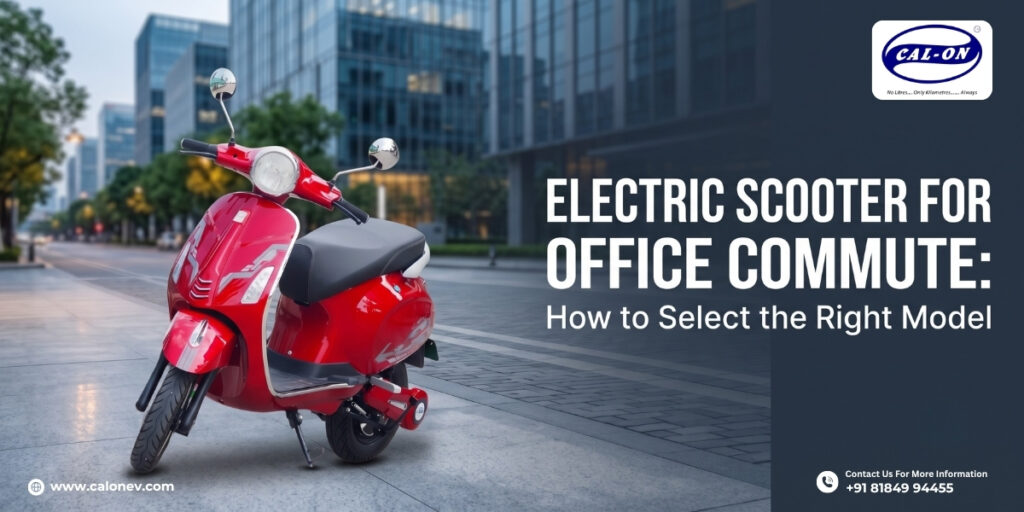
For many working professionals, the daily journey to the office is more than just a way to get from one place to another. It is a routine that happens almost every day, often through busy roads, traffic signals, crowded streets, and unpredictable weather. When fuel prices, maintenance expenses, parking challenges, and traffic congestion are added to the equation, choosing the right two-wheeler becomes an important decision.
This is where an electric scooter for office commute can become a practical option for modern professionals. Electric scooters are designed to make every day urban transportation convenient while offering an alternative to conventional petrol-powered vehicles.
However, choosing an electric scooter should not be based only on appearance, advertised range, or price. Your daily distance, charging availability, riding comfort, battery capacity, road conditions, storage requirements, safety features, and budget all need to be considered.
The right electric scooter should fit naturally into your lifestyle. It should be comfortable during your morning ride, dependable during your evening journey, and practical enough for those unexpected trips after work.
This guide explains the key factors you should consider before purchasing an EV for your daily office travel.
Why Choose an Electric Scooter for Office Commute?
An electric scooter for office commute can be a convenient choice for professionals who travel regularly within cities and surrounding areas.
One of the biggest advantages is the simplicity of electric mobility. Instead of visiting a petrol station regularly, you can charge your scooter at home or another suitable charging location. For someone who travels to work every day, this can make the daily routine easier.
Electric scooters can also be well suited to stop-and-go urban traffic. Their straightforward controls and smooth electric power delivery can make frequent acceleration and deceleration more manageable.
Another consideration is running cost. Electricity used for charging can potentially cost less than the fuel required for an equivalent journey, although actual savings depend on electricity tariffs, vehicle efficiency, riding conditions, and usage.
For office professionals, convenience is often just as important as cost. Being able to charge at home overnight and start the next morning with a sufficient battery can make commuting much more predictable.
However, every commuter has different requirements. A person travelling 10 kilometres a day will have different needs from someone travelling 50 kilometres. That is why understanding your own commute should be the first step.
Understand Your Daily Travel Requirements
Before searching for an electric scooter for daily commute, calculate how much you actually travel.
Don’t consider only the distance between your home and office. Think about the entire day’s journey.
For example, your routine could include:
- Home to office
- Office to a restaurant or shop
- Short trips during working hours
- Office to the market
- Office back home
These additional kilometres can add up quickly.
Write down your approximate daily distance for a normal working week. If possible, also consider occasional longer trips. This will help you determine how much practical range you need.
You should also consider the type of roads you use. A flat route through city streets will place different demands on a scooter compared with a route involving steep roads, poor surfaces, or frequent high-speed travel.
Traffic conditions matter too. Stop-and-go traffic, frequent braking, and repeated acceleration can affect energy consumption.
Understanding your routine will help you avoid buying a scooter that is either underpowered for your needs or equipped with capabilities you rarely use.
How Much Range Do You Really Need?
Range is one of the most discussed specifications when people compare electric scooters. However, advertised range should not automatically be treated as the range you will achieve in every situation.
Actual performance can be influenced by:
- Rider weight
- Passenger or luggage weight
- Riding speed
- Traffic
- Road conditions
- Weather
- Tyre pressure
- Acceleration habits
- Terrain
- Use of electrical features
This is why electric scooter mileage for daily commute should be evaluated in the context of real-world riding rather than one laboratory or test figure.
If your daily requirement is approximately 30 kilometres, choosing a scooter with a theoretical range close to 30 kilometres may not provide enough flexibility.
A reasonable range buffer is useful. It gives you additional freedom if you need to make an unexpected stop, take a longer route, or deal with conditions that reduce efficiency.
For someone with a long daily route, a long-range electric scooter for office travel can offer additional convenience. Extra range can be particularly useful when charging opportunities are limited or when the scooter is also used for personal errands.
However, buying the highest-range model isn’t always necessary. A commuter with a short daily route and convenient overnight charging may have little practical need for an extremely large battery.
Battery Capacity and Charging Time
Battery capacity directly influences how much energy an electric scooter can store. However, battery size isn’t the only specification you should consider.
Charging time is equally important.
Imagine reaching home after a busy day with a low battery. If you need the scooter again early the next morning, you should know whether the charging time fits your schedule.
For many office workers, overnight charging can be convenient. The scooter can be plugged in after returning home and charged while the owner sleeps.
If your workplace offers charging facilities, you may have even greater flexibility.
When evaluating an electric scooter for work commute, think about your complete charging routine. Ask yourself where you will charge, when you will charge, and whether the charging time fits naturally into your schedule.
Also follow the manufacturer’s instructions regarding charging equipment and charging practices.
Comfort Matters More Than You Think
A short test ride can sometimes make a scooter seem comfortable, but your experience may be very different after using it every working day.
Consider how long you spend on the road.
If your journey takes 45 minutes each way, you could spend around 90 minutes riding every working day. Over a month, that becomes a substantial amount of time.
For this reason, check:
- Seat comfort
- Riding position
- Handlebar height
- Footboard space
- Suspension
- Seat height
- Steering feel
- Ease of getting on and off
Take a proper test ride before making your decision.
An electric scooter for city commuting should feel manageable at low speeds and comfortable during traffic stops. It should also provide enough stability and suspension performance for the roads you normally use.
Don’t judge comfort from photographs or specifications alone. Your own riding experience is the better test.
Consider Weight and Handling
Weight can have a noticeable impact on everyday usability.
You don’t only ride a scooter. You also have to park it, reverse it, move it around tight spaces, and sometimes push it manually.
If your office parking area is crowded or your home has a narrow entrance, handling becomes particularly important.
A heavier scooter may provide a certain feel on the road, but moving it manually could require more effort. A lighter scooter may be easier to maneuver, although the ideal balance depends on the individual model and rider.
Think about your daily parking situation before purchasing.
A scooter that looks impressive on paper may not be the most convenient choice if you struggle to move it into your parking space every evening.
Storage Space for Office Essentials
Office commuters often carry more belongings than they realize.
A typical working day might involve carrying a laptop, charger, documents, water bottle, lunch box, raincoat, or personal items.
Therefore, storage space deserves attention when comparing an electric scooter for office use.
Check the under-seat storage capacity and determine whether it can accommodate the items you regularly carry.
If it cannot, think about whether you are comfortable carrying a backpack or using a suitable storage accessory.
Practical convenience is often overlooked during the buying process. Yet small things such as storage can have a significant impact on your daily experience.
Performance for City Traffic
You don’t necessarily need extreme performance for commuting.
Most office riders spend a considerable amount of time in traffic. Smooth acceleration, predictable braking, easy maneuverability, and stable handling may be more useful than a very high top speed.
The scooter should have enough performance for your normal route, including flyovers, slopes, and faster stretches of road where applicable.
For daily urban travel, consistency is important.
You want a scooter that responds predictably whenever traffic starts moving, stops suddenly, or requires you to change position.
The goal is not to choose the most powerful vehicle available. It is to choose one whose performance suits your actual commute.
What Makes the Best Electric Scooter for Office Commute?
Many buyers search for the best electric scooter for office commute, but there is no single model that will be ideal for every professional.
Consider two hypothetical commuters.
The first travels 12 kilometres per day, has home charging, and mainly rides through crowded city streets. Comfort, affordability, and easy handling may be their priorities.
The second travels 45 kilometres every day and occasionally makes additional trips after work. Range and battery capacity may be more important for them.
Both are office commuters, but their requirements are different.
Therefore, instead of choosing a scooter because someone calls it the “best,” create your own checklist.
Your checklist could include:
- Daily range
- Charging time
- Comfort
- Battery capacity
- Storage
- Safety
- Service availability
- Warranty
- Budget
- Performance
This approach allows you to compare scooters according to your actual lifestyle.
Finding an Affordable Electric Scooter for Commuting
Price is naturally an important consideration for most buyers.
However, an affordable electric scooter for commuting shouldn’t simply mean the cheapest model you can find.
Think about total ownership cost.
Your expenses may include:
- Purchase price
- Electricity
- Insurance
- Maintenance
- Tyres
- Accessories
- Service
- Financing
- Potential battery-related expenses
A slightly higher initial investment may make sense if the scooter provides features and specifications that genuinely suit your daily needs.
At the same time, don’t pay extra for features you won’t use.
For example, if your daily route is short and you can easily charge at home, spending substantially more only for additional range may not be necessary.
Value comes from matching the vehicle to your requirements.
Choosing a Long-Range Model
A long-range electric scooter for office commuting can be particularly useful for professionals with long routes or unpredictable schedules.
Additional range can provide peace of mind when you need to make an unexpected trip after work. You might need to visit a client, pick up groceries, meet a friend, or take a longer route home.
However, additional battery capacity may also influence vehicle weight and purchase price.
Ask yourself how frequently you actually need the extra range.
If your daily commute is only 15 kilometres and you have convenient charging, an extremely long-range model may not provide enough additional value to justify the extra expense.
The ideal choice depends on your routine.
Safety Features to Check
Safety should never be treated as an optional feature.
When evaluating an electric scooter for city commuting, look closely at braking performance, tyres, lighting, visibility, and overall stability.
Good headlights and rear lights are particularly useful if you travel early in the morning or return from work after sunset.
Tyres should provide suitable grip for the road conditions you regularly encounter.
Braking should feel predictable and controlled.
You should also wear appropriate protective equipment, especially a properly certified helmet.
Remember that a safe commute depends not only on the vehicle but also on riding behaviour, road awareness, and responsible use.
Suspension and Indian Road Conditions
Anyone who regularly travels on Indian roads knows that road surfaces can change dramatically within a few kilometres.
You may encounter smooth roads, potholes, speed breakers, uneven surfaces, construction areas, and rough patches during the same commute.
This makes suspension an important consideration.
When testing a scooter, try to understand how it behaves on different surfaces. Pay attention to how comfortably it handles bumps and whether you feel stable when travelling over uneven sections.
For commuters, comfort isn’t just about the seat. Suspension, tyres, riding position, wheel size, and overall vehicle balance can all contribute to the quality of the ride.
Maintenance and Service Support
Electric scooters have a different mechanical architecture from petrol scooters, but that doesn’t mean they require no maintenance.
You still need to monitor:
- Tyres
- Brakes
- Suspension
- Lights
- Electrical systems
- Battery condition
- Charging equipment
Regular inspection can help identify potential problems early.
Service availability is equally important.
Before purchasing, find out where authorized service support is available and how easily you can access it.
For an electric scooter for work commute, dependable service support can be particularly valuable because your vehicle is part of your daily working routine.
Warranty and Battery Support
The battery is one of the most important components of an EV, so warranty coverage deserves careful attention.
Before purchasing, understand:
- Battery warranty duration
- Conditions of warranty coverage
- Vehicle warranty
- Charging equipment coverage
- Service procedures
- Replacement policies
- Authorized service locations
Don’t assume every component is covered in exactly the same way.
Read the warranty terms and ask the dealer about anything you don’t understand.
CAL-ON EV customers should refer to the warranty documentation and applicable support information for the specific model they are considering.
How to Choose an Electric Scooter for Your Route
Understanding how to choose an electric scooter becomes easier when you work through your requirements systematically.
- First, calculate your daily distance.
- Second, identify where you can charge.
- Third, consider your road conditions.
- Fourth, decide what level of comfort you require.
- Fifth, determine how much storage you need.
- Sixth, establish your realistic budget.
- Seventh, compare warranty and service support.
Finally, take a test ride.
This process prevents you from making a decision based solely on advertisements or one impressive specification.
Your scooter should be selected according to your actual lifestyle.
An Electric Scooter Buying Guide for Commuters
A practical electric scooter buying guide for commuters should focus on everyday usability rather than just specifications.
Start by writing down your daily round-trip distance.
Then determine your minimum practical range. Add a buffer for unexpected travel.
Next, check charging availability. Home charging can be convenient, but workplace charging can provide additional flexibility.
After that, evaluate comfort, storage, handling, suspension, braking, lighting, and other features that affect your daily experience.
Finally, compare the total cost of ownership.
Don’t rush the process simply because you like the appearance of a particular model.
A few hours of research and a proper test ride can help you avoid years of inconvenience.
Why CAL-ON EV Can Be Considered
CAL-ON EV focuses on electric mobility solutions designed for practical transportation requirements.
For office commuters, the important question is not simply whether an EV looks attractive. It is whether the particular model fits the rider’s daily requirements.
When considering a CAL-ON EV model, evaluate its range, battery specifications, payload capability, charging requirements, comfort, and other features against your personal commute.
A professional who uses the scooter primarily for office travel may have different requirements from someone who also uses the vehicle for business deliveries or longer daily journeys.
The best approach is to understand your requirements first and then compare them with the specifications of the model.
Common Mistakes to Avoid
Buying an EV can be exciting, but several common mistakes are worth avoiding.
Choosing Only by Price
The lowest purchase price doesn’t necessarily represent the best overall value.
Focusing Only on Claimed Range
Actual range can vary based on speed, load, terrain, traffic, weather, and riding style.
Ignoring Charging
A scooter that doesn’t fit your charging routine can become inconvenient.
Skipping the Test Ride
Comfort and handling are difficult to judge from a brochure.
Forgetting Service Support
Always know where you can get authorized service.
Buying More Than You Need
Extra range or features can increase the cost without necessarily improving your daily experience.
Final Checklist Before Buying
Before purchasing your scooter, ask yourself these questions:
- What is my actual daily distance?
- How much range do I realistically need?
- Where will I charge the scooter?
- How long does charging take?
- Is the seat comfortable?
- Can it handle my regular roads?
- Is there enough storage?
- Does it provide suitable braking and lighting?
- What warranty is included?
- Where can I get it serviced?
- Does the price fit my budget?
- Does the scooter match my everyday routine?
If you can answer these questions confidently, you’ll be in a much stronger position to make your decision.
Final Thoughts
Choosing an electric scooter for office commute is about more than finding a vehicle with an attractive design or impressive specifications. It is about finding a practical companion for your everyday routine.
Start by understanding your commute. Calculate your daily distance, consider your charging options, and determine how much range you genuinely need.
Then look at comfort, battery capacity, charging time, storage, performance, suspension, safety, warranty, and service support.
An electric scooter for office commute can be a practical choice for professionals who want a convenient alternative for regular urban travel. But the ideal model will depend on the individual rider.
Whether you’re considering CAL-ON EV or comparing multiple electric scooter brands, take the time to match the specifications with your real-world requirements.
Don’t ask only, “Which scooter has the highest range?” or “Which one costs the least?”
Instead, ask a more useful question:
Which scooter fits the way I actually travel every day?
That answer will help you make a more practical and confident purchase.
Also Read: Electric Scooter Battery Life: How Long Does an EV Battery Last? – CAL-ON EV
Frequently Asked Questions
1. What should I look for in an electric scooter for office commute?
A: Consider daily range, charging time, comfort, battery capacity, storage, braking, suspension, warranty, service support, and total ownership cost. Your route and daily routine should determine which specifications matter most.
2. How much range do I need for an electric scooter for daily commute?
A: Calculate your complete daily travel, including trips beyond your home-to-office journey. Then select a model that provides a practical range buffer rather than choosing one whose claimed range barely covers your daily distance.
3. Is an affordable electric scooter for commuting a good option?
A: Yes, provided its specifications match your requirements. When evaluating an affordable electric scooter for commuting, consider purchase price as well as charging costs, maintenance, warranty, service availability, and other ownership expenses.
4. How do I choose an electric scooter for my office commute?
A: When deciding how to choose an electric scooter, begin with your daily distance and charging availability. Then compare range, comfort, safety, battery specifications, storage, performance, warranty, service support, and overall cost.
5. What should I check before buying an electric scooter?
A: A useful electric scooter buying guide for commuters should include range, charging time, battery, comfort, suspension, braking, storage, safety, warranty, service support, and budget. A test ride is also recommended before making your final decision.