
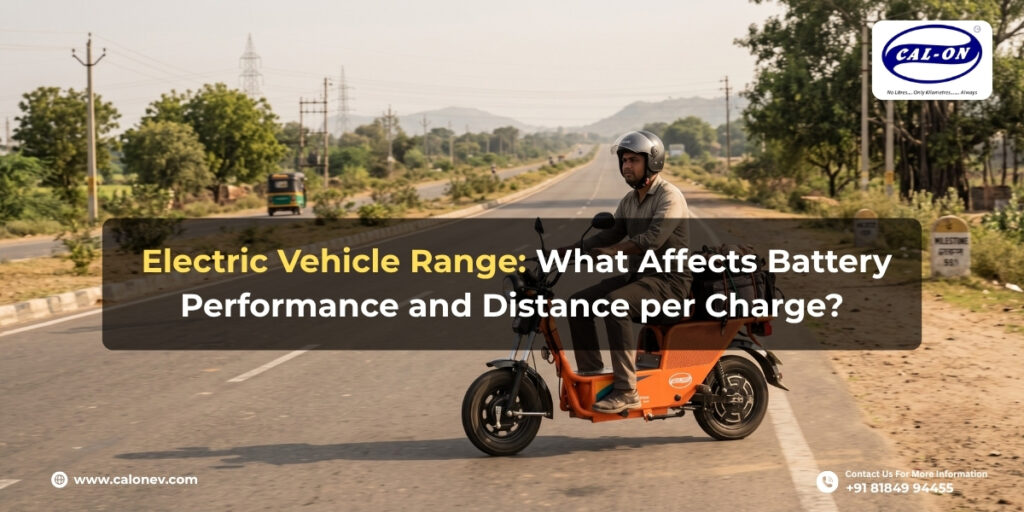
Imagine leaving home for work with a fully charged electric scooter, only to notice that the battery percentage is dropping faster than expected. You may start wondering whether the battery is losing its efficiency or whether your riding habits are affecting its performance.
This is a common concern among electric vehicle owners. The distance an EV can travel depends on more than just the battery size. Riding speed, road conditions, vehicle load, weather, tyre pressure, and battery health can all influence how far you travel between charges.
Understanding electric vehicle range helps you choose the right vehicle, plan daily journeys, and get more value from every charge. Whether you use an electric two-wheeler for commuting or commercial deliveries, knowing what affects performance can make every day riding easier.
In this guide, we will explore the main factors that influence distance per charge and share practical ways to make your EV journeys more efficient.
What Does Electric Vehicle Range Mean?
An EV’s range refers to the distance it can travel using the energy stored in its battery before it needs to recharge. Manufacturers usually provide an estimated range based on specified testing conditions, but your everyday results may differ.
For example, a scooter advertised with a particular range may deliver a different distance when carrying a heavy load, travelling uphill, or operating in very hot weather.
The electric vehicle range per charge is especially important for people who depend on their vehicles for daily travel. Office commuters want to reach work and return home comfortably, while delivery riders need enough distance to complete their routes without frequent charging breaks.
It is helpful to distinguish between a manufacturer’s claimed range and the distance you actually achieve. Your riding conditions and habits play a major role in that difference. The US National Highway Traffic Safety Administration also explains that battery temperature and thermal management can influence EV performance and energy use.
1. Battery Capacity and Overall EV Battery Performance
Battery capacity is one of the most important factors influencing how far an EV can travel. It describes how much energy the battery can store, commonly measured in kilowatt-hours (kWh) for electric cars and in other specifications, including volts and ampere-hours, for two-wheelers.
In general, a larger usable battery capacity can support a longer journey when other conditions are similar. However, battery size alone does not guarantee the best results. Vehicle weight, motor efficiency, battery management, and energy consumption also matter.
Good EV battery performance depends on both the battery’s design and how the vehicle uses its stored energy.
When comparing electric two-wheelers, consider these points:
- Battery capacity and battery chemistry
- Manufacturer-claimed range and the conditions used to estimate it
- Charging time and battery warranty
- Availability of authorised servicing
- Vehicle weight and intended riding conditions
The electric vehicle battery capacity should suit your daily needs. A commuter travelling a short distance may not need the same capacity as someone who regularly covers long routes for work.
2. Riding Speed and Acceleration
Your riding style can have a noticeable effect on the distance you get from a charge. Frequent rapid acceleration, sudden braking, and consistently riding at high speeds can increase energy consumption.
Smooth acceleration allows the motor to deliver power more efficiently. Anticipating traffic and slowing down gradually can also reduce unnecessary energy use.
These are important factors affecting EV battery range, particularly for riders travelling through busy city streets.
Try these practical habits:
- Accelerate smoothly instead of twisting the throttle aggressively.
- Maintain a steady, safe speed where road conditions allow.
- Anticipate traffic signals and avoid unnecessary sudden braking.
- Use the vehicle’s recommended riding mode.
- Follow the manufacturer’s guidance on regenerative braking, if available.
Regenerative braking can recover some energy during deceleration on vehicles equipped with this feature, although the amount recovered varies. It should not replace safe braking practices.
3. Weather and Temperature Conditions
Weather can affect battery operation and the energy required to run an electric vehicle. Extreme heat may increase the energy needed to manage battery temperature, while cold conditions can reduce battery efficiency and available range in some vehicles.
In India, high summer temperatures can be a concern for riders who park outdoors for long periods. Direct sunlight and poor storage conditions may also expose the vehicle to unnecessary heat.
To help maintain consistent electric scooter range, park in a shaded, suitable location whenever possible and follow the manufacturer’s temperature and charging recommendations.
Rain, strong winds, and wet roads can also affect energy consumption and riding conditions. Always prioritise safe riding rather than attempting to maximise distance in bad weather.
Remember that battery behaviour differs by chemistry and vehicle design. A change in range during unusual weather does not automatically mean the battery is damaged.
4. Vehicle Load and Road Conditions
Carrying additional weight requires more energy, particularly when accelerating or travelling uphill. This matters for riders who carry passengers, luggage, tools, or delivery packages.
If your vehicle is frequently used for commercial purposes, choose a model designed for your typical load. Never exceed the manufacturer’s specified carrying capacity.
Road conditions also play a role. Rough surfaces, steep climbs, frequent stops, and uneven routes can increase energy consumption compared with a smoother, more consistent journey.
To manage these factors affecting EV battery range, plan your route where practical, remove unnecessary cargo, and keep your tyres properly inflated according to the vehicle manual.
A vehicle that works well for a light daily commute may deliver different results when used for heavy-duty transportation. Consider your real usage before choosing a model.
5. Tyre Pressure and Electric Scooter Battery Efficiency
Tyres are easy to overlook, but their condition can affect how efficiently a vehicle moves. Underinflated tyres can increase rolling resistance, meaning the motor needs more energy to keep the vehicle moving.
Maintaining the recommended tyre pressure supports handling, tyre life, and energy efficiency. Check the tyres regularly, especially before longer journeys or when carrying a load.
Good electric scooter battery efficiency also depends on routine vehicle care. Worn tyres, mechanical drag, or components that need servicing may affect performance.
Make these checks part of your routine:
- Check tyre pressure using the manufacturer’s recommended values.
- Look for punctures, cuts, and uneven tyre wear.
- Follow the recommended service schedule.
- Pay attention to unusual noises or changes in handling.
- Have suspected mechanical problems checked by a qualified technician.
These simple steps can help your vehicle operate as intended and make its range more predictable.
6. How to Increase Electric Vehicle Range Through Better Habits
You do not need complicated techniques to improve everyday efficiency. A few consistent habits can help you make better use of your battery.
If you are wondering how to increase electric vehicle range, start with your riding style and vehicle maintenance.
Ride smoothly: Avoid unnecessary rapid acceleration and sudden braking.
Maintain tyre pressure: Proper inflation helps reduce rolling resistance.
Reduce unnecessary weight: Carry only what you need and remain within the vehicle’s load limit.
Plan your route: Where practical, choose a route with smoother roads and fewer avoidable detours.
Follow charging guidance: Use the recommended charger and battery-care practices for your model.
Keep up with servicing: Ask a qualified technician to investigate unexplained range loss or battery warnings.
The goal is not to ride slowly in every situation or compromise safety. It is to use energy sensibly while following traffic rules and the manufacturer’s instructions.
7. Understanding EV Range in India
The EV range in India varies according to the vehicle, battery capacity, road conditions, riding patterns, and weather. City traffic can involve frequent stopping and starting, while some longer routes may include higher speeds, uneven roads, or steep inclines.
Your daily requirements are therefore more useful than a single advertised number when comparing models.
For example, a person commuting to an office may need enough range for the round trip plus a reasonable reserve. A delivery rider may need to account for multiple stops, changing loads, and additional kilometres during the working day.
Before buying, consider:
- Your average daily travel distance
- Whether you can charge at home or at work
- The availability of service centres
- The usual road and weather conditions
- The amount of reserve range you want for unexpected trips
CAL-ON EV encourages buyers to evaluate electric mobility options according to their practical needs, including commuting and utility applications. Comparing vehicle specifications with your real route can help you make a more informed choice.
8. Claimed Range Versus Electric Scooter Real-World Range
The manufacturer’s range figure is useful for comparing models, but it should not be treated as a guaranteed distance for every journey.
The electric scooter real-world range may differ because testing conditions do not perfectly match every rider’s experience. Speed, load, temperature, tyre pressure, battery condition, and route profile can all affect the final result.
For a more realistic estimate, observe how your own vehicle performs over several journeys. Record the distance travelled, starting charge, ending charge, load, and general riding conditions. This can help you understand your vehicle’s typical consumption.
When comparing scooters, look for clear information about the range claim and ask the dealer how the model performs under conditions similar to yours. Avoid assuming that two scooters with similar advertised ranges will necessarily deliver identical results.
9. Battery Health and Long-Term Range
A battery’s condition can change as it ages and completes charging cycles. Over time, some loss of usable capacity is normal, but a sudden or significant drop in distance deserves attention.
To support long-term EV battery performance, follow the charging instructions for your particular battery chemistry. Avoid leaving the vehicle in extreme temperatures for extended periods, use compatible charging equipment, and arrange servicing when the vehicle displays a warning.
Do not rely on universal charging rules without checking the manual. Different battery designs may have different recommendations for daily charging and long-term storage.
If the vehicle’s range falls sharply, charging becomes irregular, or warning indicators appear, contact an authorised service centre rather than attempting to open or repair the battery yourself.
Final Thoughts
Understanding what affects distance per charge helps you make better decisions as an EV owner. Battery capacity matters, but so do riding habits, weather, road conditions, vehicle load, tyre pressure, and regular maintenance.
The most useful approach is to choose a vehicle suited to your daily travel and learn how it performs in your actual conditions. With sensible riding habits and proper care, you can make journeys more predictable and use your battery’s energy more effectively.
For CAL-ON EV customers and anyone exploring electric mobility, informed comparison is a practical first step towards a confident ownership experience.
Also Read: Electric Vehicle Battery Safety: Charging Habits and Maintenance Practices – CAL-ON EV
Frequently Asked Questions
1. What factors affect an electric vehicle’s range the most?
A: Battery capacity, speed, acceleration, temperature, vehicle load, road conditions, tyre pressure, and battery health can all influence range.
2. Does riding speed affect electric scooter range?
A: Yes. Frequent rapid acceleration and consistently high speeds can increase energy consumption. Smooth riding at a safe, suitable speed can help improve efficiency.
3. How can I improve my electric vehicle’s distance per charge?
A: Maintain recommended tyre pressure, reduce unnecessary load, ride smoothly, follow charging guidance, and keep the vehicle properly serviced.
4. Why is my electric scooter delivering less range than advertised?
A: Advertised range is generally based on specified testing conditions. Real-world range may be lower because of traffic, load, weather, speed, road conditions, and battery age.
5. Does battery capacity alone determine EV range?
A: No. A larger battery can store more energy, but actual range also depends on vehicle efficiency, motor performance, weight, riding habits, and environmental conditions.